
Ask anyone how their subreddit is doing and you will get a subscriber count. It is the number Reddit puts at the top of the page, it is the number that goes in the deck, and it is close to meaningless on its own.
Subscribers is a cumulative, unfalsifiable, never-decreasing number. It includes everyone who joined in 2019 and has not opened Reddit since. A subreddit with 40,000 members and nine comments a day is a worse community than one with 3,000 members and two hundred, and the headline number says the opposite.
Here is what to look at instead, where to find it, and which numbers you have to construct yourself because Reddit will not give them to you.
The Numbers That Tell You Something
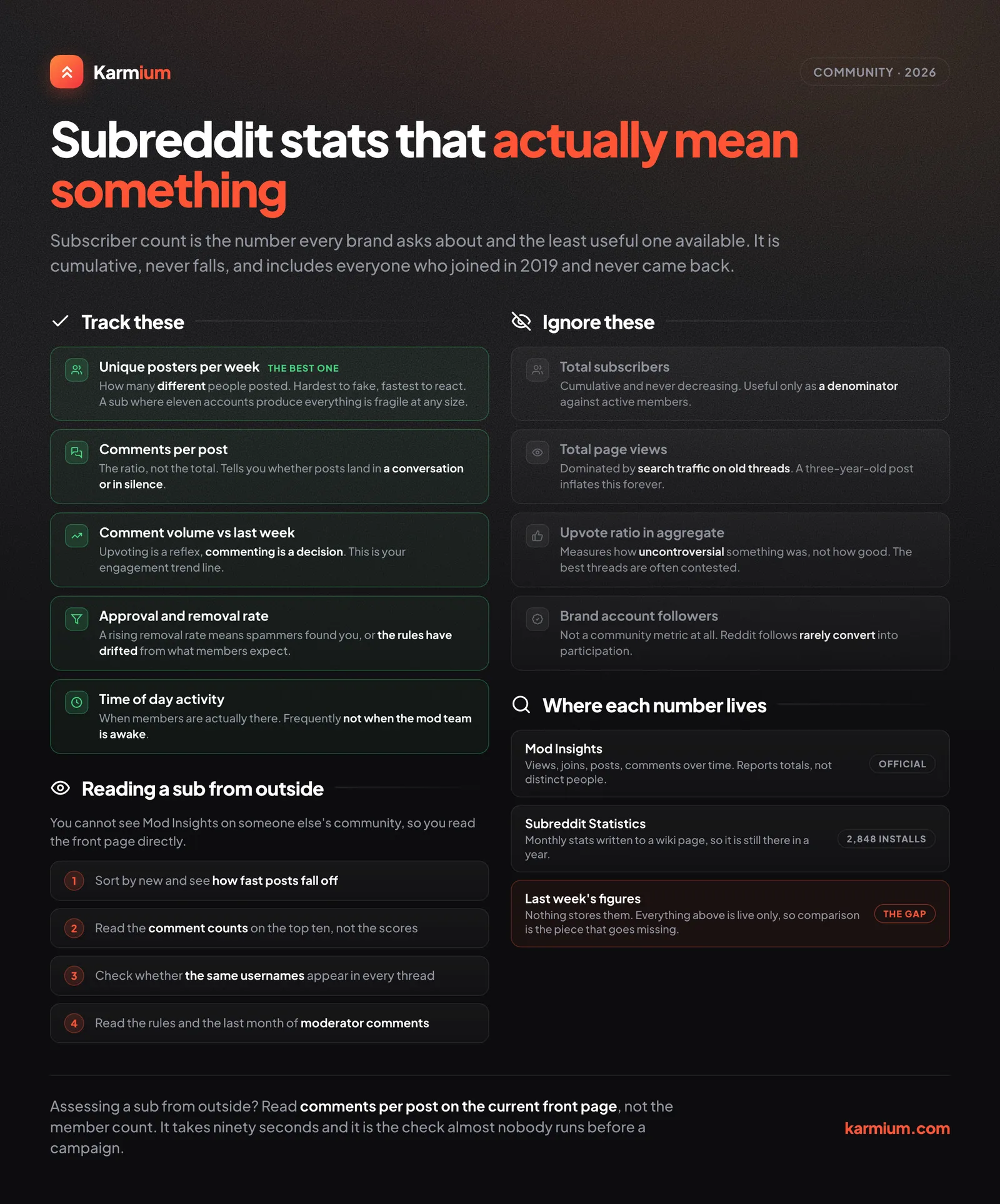
Unique posters per week. How many different people posted, not how many posts there were. This is the single best health metric a subreddit has, because it is the hardest to fake and the fastest to react. A community where the same eleven accounts produce everything is fragile no matter how large it is, and a rising unique-poster count is the clearest evidence that a community is genuinely compounding.
Comments per post. The ratio, not the total. It tells you whether posts land in a conversation or in silence. A falling ratio while post volume rises usually means the content mix has shifted towards things nobody has anything to say about, which is a fixable problem if you catch it.
Comment volume against last week. Comments are the closest proxy Reddit offers for effort. Upvoting is a reflex, commenting is a decision. Tracked week over week, this is your engagement trend line.
Post approval and removal rate. What proportion of submissions survive. A rising removal rate usually means either the subreddit is being discovered by spammers, or the rules have drifted away from what people expect the community to be for. Both are worth knowing early.
Time of day activity. When your members are actually there. This determines when to post anything you care about, and it is frequently not when the mod team is awake.
The Numbers That Mislead
Total subscribers. Covered above. Useful only as a ratio against active members.
Total page views. Reddit reports these, and they are dominated by search traffic landing on old threads. A three-year-old post ranking on Google will inflate views indefinitely while telling you nothing about the community.
Upvote ratio on individual posts. Interesting for a single post, noise in aggregate. It measures how uncontroversial something was, not how good it was, and the best threads in most communities are frequently the contested ones.
Follower counts on the brand account. Not a community metric at all. Reddit follows are weak and rarely convert into subreddit participation.
Where Each Number Lives
Reddit splits this across several places, which is most of why nobody tracks it consistently.
Mod Insights, in the subreddit’s mod tools, gives you views, joins, posts and comments over time. It is the official source and it is fine for trend direction. Its main limitation is that it reports totals rather than distinct participants, so it cannot answer the unique-posters question.
Subreddit Statistics (sub-stats-bot, around 2,800 installs) writes detailed monthly post and comment statistics to a wiki page automatically. This is the most common way moderators get a persistent record, and a wiki page has the useful property of still being there in a year.
postanalytics is a lighter option covering daily post statistics, peak activity hours and top contributors, aimed at exactly the time-of-day question above.
Your own weekly record. For the comparison numbers, something has to store last week’s figures, because Reddit does not keep them for you. This is the gap most tracking falls into: everything is available live, almost nothing is available historically.
The Part Nobody Tracks
Notice what is missing from all of the above. Every tool listed reports numbers to moderators, in a dashboard or a wiki page that members never see.
That is a reasonable default for spam metrics. It is a waste for the growth ones, because a community’s numbers are also content. “We passed 5,000 members this week, comments are up 20%, and here are the three people who drove it” is a genuinely good post. It is the kind of thing members respond to, and it costs nothing beyond the numbers you already have.
This is the case for putting the reporting in the subreddit rather than the mod panel. Our own app, Community Recap, was built around that idea: it publishes a weekly post that includes a by-the-numbers section (new posts, comments, unique posters and total members, each compared against the previous week) alongside the week’s top posts, most discussed threads and best comments. The comparison works because the app stores each week’s figures, which is the piece a live dashboard cannot do.
It is free, installs from the App Directory, and previews to your inbox before it posts anything. The full walkthrough of the format is here, and if you want the broader landscape, we ranked the most installed moderation apps by real install counts.
How to Read a Subreddit You Do Not Moderate
Worth covering separately, because this is the more common marketing question: how do you assess a community you want to post in, from outside?
You cannot see Mod Insights, so you are reading the front page directly. Sort by new and see how fast posts fall off. Look at the comment counts on the current top ten, not the scores. Check whether the same handful of usernames appear in every thread. Read the removed-post pattern by sorting new and noticing the gaps. And read the rules and the last month of moderator comments, which will tell you more about whether promotion is tolerated than any metric will.
The mistake is assessing a subreddit by size and posting into a large, dead one. Comments per post on the current front page answers that in about ninety seconds, and it is the check almost nobody runs before a campaign. If you want the fuller version of that assessment, we cover it in the rules layer that gets brands removed.
The Short Version
Track unique posters, comments per post, and week-over-week comment volume. Ignore subscriber count except as a denominator. Store your own history, because Reddit will not. And consider publishing the growth numbers to your members rather than keeping them in a dashboard, because a community that can see itself growing behaves differently from one that cannot.
Trying to work out whether a community is worth investing in, or what to measure once you have one? Tell us what you are looking at.